





Consilium Medicum
Peer-review medical journal
Editor-in-chief
- Prof. Victor V. Fomin, MD, Dr. Sci. (Medicine)
ORCID ID: https://orcid.org/0000-0002-2682-4417
Publisher
- CONSILIUM MEDICUM LLC
WEB: https://omnidoctor.ru/
About
Professional medical multidisciplinary journal , based on the principles of evidence-based medicine. Consilium Medicum magazine has been issued since 1999.
The journal publishes national and international recommendations, reviews, lectures, original works, and clinical cases dealing with the most actual problems of the modern medicine, as well as interviews with experts within the different fields of medicine and conferences, congresses and forums reviews.
The journal is practically-oriented and publishes articles by leading clinicians who are professional in the special field of medicine in Russia, Ukraine, Belarus, and includes the high level of scientific information.
Consilium Medicum journal is the most popular journal among medical practitioners. There are 12 thematic issues per year. The journal is designed for therapeutists, pediatricians, cardiologists, endocrinologists, gastroenterologists, pulmonologists, dermatologists, obstetrician-gynecologists, urologists, nephrologists, neurologists, rheumatologists and physicians in other specialties, as well as for resident physicians, post-graduate students and senior students at medical universities.
Types of accepted articles
- reviews, systematic reviews and meta-analysis
- original research
- clinical case reports and series of clinical cases
- letters to the editor
- hystorical articles in medicine
Research fields
- Internal medicine
- Endocrinology
- Otorhinolaryngology
- Cardiology
- Neurology
- Phthisiology
- Surgery
- Rheumatology
- Urology
- Pulmonology
- Gastroenterology
- Gerontology and geriatrics
Publication, distribution and indexation
- Russian and English full-text articles;
- issues publish monthly, 12 times per year;
- no APC, Platinum Open Access
- articles distributr under the Creative Commons Attribution-NonCommercial-ShareAlike 4.0 International License (CC BY-NC-SA 4.0).
Indexation
- Russian Science Citation Index (elibrary.ru)
- DOAJ
- CrossRef
- Google Scholar
- WorldCat
- Ulrich's Periodicals Directory
- CyberLeninka
Current Issue
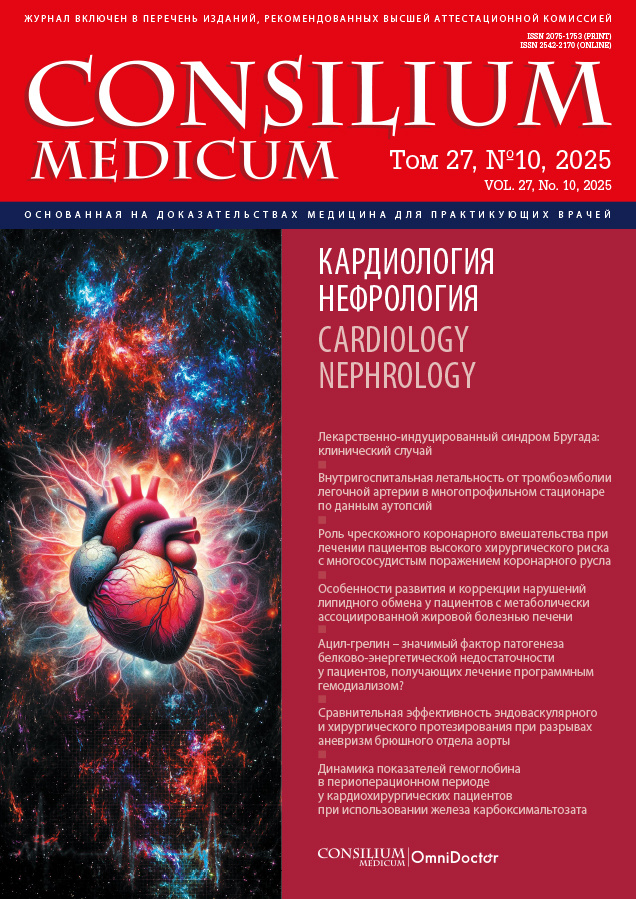
Vol 27, No 10 (2025): Cardiology and nephrology
- Year: 2025
- Published: 18.11.2025
- Articles: 9
- URL: https://consilium.orscience.ru/2075-1753/issue/view/13000
Full Issue

Articles
The role of percutaneous coronary intervention in the treatment of patients with multivessel coronary artery disease who are turned down for coronary artery bypass grafting (literature review)
Abstract
Despite the development of modern technologies in the field of healthcare and the wide application of modern diagnostic and treatment methods, mortality from ischemic heart disease remains the leading cause of death among diseases. It is known that coronary artery bypass grafting in combination with optimal medical therapy is the gold standard for treating patients with multivessel coronary artery disease. However, for several decades now, percutaneous coronary intervention has proven to be an alternative method of myocardial revascularization for patient with multivessel coronary artery disease and low or intermediate risk. Nevertheless, despite accumulated experience in treating patients with ischemic heart disease, the choice of revascularization method for patients with complex coronary artery disease and high surgical risk (not eligible for CABG) remains debatable. In this review article, the authors described the main factors influencing the choice of myocardial revascularization strategy and demonstrated the results of clinical studies dedicated to studying this issue.
 577-583


In-hospital mortality from pulmonary thromboembolism in a multidisciplinary hospital according to autopsy data
Abstract
Background. Pulmonary embolism (PE) is a serious complication of acute venous thrombosis. The true prevalence of PE is still not fully established, and data on postmortem diagnosis of PE often differ significantly from each other.
Aim. Identification of the real incidence and features of PE based on autopsy data from patients who died at Saint Petersburg Dzhanelidze Research Institute of Emergency Medicine in 6-years period of time.
Materials and methods. We studied 8,406 protocols of autopsy of patients who died in Saint Petersburg Dzhanelidze Research Institute of Emergency Medicine in 2018–2023. Of these, those cases in which there PE were occurred identified and analyzed. Results were statistically processed.
Results. The rate of pulmonary thromboembolism was 15.4% from all autopsies, in 10.1% of cases PE was the direct cause of death. 61.4% of females and 38.6% of males died, p < 0.05. The average age of all patients was 72.5 ± 0.4 years. 81.0% of patients were older 60 years. The ratio of males and females under the age of 60 was 1.8:1, while among all older deaths this indicator was 1:2.1. In postmortem clinical diagnoses of the deceased, PE appeared only in 59.2% of autopsies, 30.4% of the deceased were not diagnosed, and 10.4% were questionable. In 2020–2022, the number of deaths of patients with COVID-19 amounted to 20.5% of the total number of patients with PE during this period. There was no relative increase in deaths from PE and no relative change in the distribution of these patients by gender and age.
Conclusion. According to the results of our research PE was the direct cause of death in every tenth person who died in a multidisciplinary hospital. Among the deceased patients with PE under the age of 60, males significantly prevailed, while females significantly prevailed at an older age. There was no relative increase in the number of patients with PE during the COVID-19 pandemic in a multidisciplinary hospital. PE remains a difficult condition to diagnose and requires specialist’s opinion to be more vigilant about this complication.
584-588
Drug-induced Brugada syndrome: Case report
Abstract
Brugada syndrome (BrS) is an inherited clinical and electrocardiographic syndrome, related to ion channelopathies and associated with an increased risk of sudden cardiac death. The cornerstone in diagnosis remains a spontaneous type 1 Brugada-pattern on the electrocardiogram (ECG), including J point elevation of ≥ 2 mm, coved-type ST segment elevation and T wave inversion in right precordial leads. Similar ECG changes, induced by antiarrhythmic therapy, should be considered as diagnostic when combined with a documented polymorphic ventricular tachycardia or ventricular fibrillation episode, arrhythmogenic syncope, nocturnal agonal breathing or a family history of sudden cardiac death or BrS. The article represents a clinical case of drug-induced type 1 Brugada-pattern in the settings of antiarrhytmic treatment using 1C class sodium channel blocker ethacizine in a female without additional BrS criteria, with negative genetic testing results and the ECG normalization after drug withdrawal.
589-593
Features of the development and treatment of lipid metabolism disorders in patients with metabolic dysfunction-associated steatotic liver disease: A review
Abstract
Nonalcoholic or metabolic dysfunction-associated steatotic liver disease (MASLD) is one of the most common noncommunicable diseases in the world. Currently, there is sufficient evidence supporting a close relationship between MASLD and lipid metabolism disorders, leading to a significant progression of cardiovascular diseases. The review addresses the current aspects of diagnosing and treating patients with MASLD and lipid metabolism disorders.
594-603
Comparative effectiveness of endovascular and surgical repair of ruptured abdominal aneurysm
Abstract
Background. Abdominal aortic aneurysm rupture is a life threating condition, that requires emergent intervention. At the present stage endovascular aortic repair should be performed, when possible, as a first line strategy, but stent-grafts have some anatomical limitations for use, so surgical repair is still performed in urgent situations.
Aim. To evaluate the results of endovascular and surgical repair of ruptured abdominal aortic aneurysms in vascular center on the base of regional hospital.
Materials and methods. In Krasnoyarsk Regional Clinical Hospital all kinds of aortic interventions are performed, both in acute and stable pathologies. During 5 years 63 patients with acute rupture of abdominal aneurysms where transferred, 31 underwent endovascular repair, 32 – surgical repair. Clinical characteristics, initial state and time for intervention didn’t differ in endovascular and surgical groups.
Results. Technical success was 100% in both endovascular and surgical repair groups. 30-day mortality with endovascular repair was 4 (12.9%) patients, and it was statistically lower compare to surgical repair group – 11 (34%) patients (p = 0.011). Repeat interventions were performed in both groups, without statistical significance in frequency. The superiority of less invasive intervention is seen during 1 year follow up: in endovascular group 1-year survival is 74.2% vs 45.5% in the surgical group (р = 0.039).
Conclusion. In real-life practice endovascular approach demonstrate convincing advantage in 30-day mortality rate in the treatment of patients with abdominal aneurism rupture. The main reason for surgical repair performing in our hospital is the presence of juxta renal aneurysm.
604-608
Analysis of renal function in patients after scheduled orthopedic intervention on lower limb joints in real clinical practice
Abstract
Background. Osteoarthritis (OA) with severe pain syndrome is the main reason for total arthroplasty of lower extremity joints. Majority of patients with OA are elderly people with comorbidities who take multiple medications, including nonsteroidal anti-inflammatory drugs (NSAIDs), that increases the risk of renal dysfunction.
Aim. To evaluate the frequency of renal dysfunction in patients undergoing scheduled arthroplasty of lower extremity joints in real clinical practice, the impact of NSAIDs and pain syndrome.
Materials and methods. The study included 1493 patients who underwent scheduled arthroplasty of the hip or knee joint. All patients provided information on concomitant diseases, previously prescribed therapy, pain severity on a ten-point scale and need for NSAIDs; serum creatinine level was assessed and glomerular filtration rate (GFR) was calculated using the Chronic Kidney Disease Epidemiology Collaboration formula with determination of the stage of chronic kidney disease (CKD). At 1, 3 and 6 months after surgery, patients were contacted and pain severity and need for NSAIDs were assessed.
Results. The study population included 636 men (42.6%) and 857 women (57.4%). Of these, 84.9% of patients were taking NSAIDs. The mean preoperative GFR was 73.2 ± 15.2 ml/min/1.73 m2 (14.3% of patients had CKD stage 3a, 4.8% – CKD stage 3b, and 0.3% – CKD stage 4). The median pain score before surgery was 8 [7; 9] points, and after 3 months it was 1 [0; 3] point. During the study period, 54 patients were readmitted for scheduled arthroplasty on the second joint. In this sample, an increase in GFR (p < 0.001) and a decrease in the CKD stage (p < 0.001) were found, that correlated with less pain compared to the first surgery and a decrease in the need for NSAIDs (r = 0.684; p < 0.001).
Conclusion. Patients undergoing scheduled surgical treatment of OA are characterized by a high incidence of CKD and a significant burden of NSAIDs. In the postoperative period, a decrease in pain severity, use of NSAIDs and a statistically significant relationship between these factors with an increase in GFR and a decrease in the stage of CKD are found. This confirms the need to implement non-drug pain relief methods and patient education for OA.
609-613
Is acyl-ghrelin a significant factor in the pathogenesis of protein-energy wasting in patients receiving haemodialysis?
Abstract
Aim. To clarify the role of acyl-ghrelin in the development of protein-energy wasting of haemodialysis patients (HD).
Materials and methods. A total of 645 patients receiving treatment with programmatic bicarbonate HD for 8.4 ± 5.3 years, including 345 women and 300 men, the average age was 56.8 ± 12.8 years. Nutritional status was assessed using the method proposed by the International Society of Renal Nutrition and Metabolism (ISRNM). For the quantitative determination of acyl-ghrelin, the enzyme-linked immunosorbent assay kit “Active Ghrelin ELISA Kit” (highly sensitive method) from Sceti KK, Japan was used in this work. Reference values: 30–62 fmol/ml.
Results. The prevalence of protein-energy wasting (PEW) using the ISRNM method was 24.9% (160 patients). Reduced levels of acyl-ghrelin were detected in 352 (54.5%) patients. The average acyl-ghrelin values in patients without signs of PEW were 50.2 ± 10.3 fmol/ml, and in patients with PEW 24.9 ± 9.2 fmol/ml (p < 0.0001). Patients with reduced acyl-ghrelin levels had statistically significantly lower values of total protein, albumin, prealbumin, total cholesterol, and transferrin than patients with normal acyl-ghrelin levels (p < 0.0001, p < 0.0001, p < 0.0001, p < 0.001 and p < 0.0001, respectively). Also, patients with reduced acyl-ghrelin levels were characterized by statistically significantly lower values of BMI, skeletal muscle mass, and percentage of body fat mass (p < 0.001, p < 0.001, p < 0.001, respectively).
Conclusion. The prevalence of PEW in HD patients according to the ISRNM method was 24.9%. A reduced level of acyl-ghrelin in the blood serum may be an important pathogenetic link in the development of PEW in HD patients.
614-619
ADAMTS-4 as cardiovascular biological marker in atherosclerosis (literature review)
Abstract
Cardiovascular diseases are a serious problem for medicine, society and economy all over the world. Currently, there is an active search for new biological markers and therapeutic targets in order to develop effective approaches to risk stratification and secondary prevention of cardiovascular pathology. The range of scientific interests of researchers recently includes the study of disintegrin and metalloproteinase with thrombospondin motifs (ADAMTS) in atherosclerosis and related diseases. ADAMTS regulate the structure and function of extracellular matrix components. In our scientific review, we analyze current experimental and clinical studies devoted to the study of ADAMTS-4 as a new diagnostic and prognostic marker in atherosclerosis. The studies conducted to date indicate the important role of this biological marker in the pathogenesis and diagnosis of atherosclerosis. Future large-scale preclinical and clinical studies are expected to show that ADAMTS-4 may be a valuable addition to laboratory diagnostic methods. Regulation of ADAMTS-4 levels and expression may be an effective strategy for the treatment of patients with atherosclerosis.
620-624
Changes in hemoglobin levels during the perioperative period in cardiosurgical patients receiving ferric carboxymaltose
Abstract
Aim. To study the change of hemoglobin (Hb) levels in the perioperative period with the intravenous administration of ferric carboxymaltose (FCM) in cardiosurgical patients.
Materials and methods. The retrospective study included data from the medical charts of 113 cardiac surgical patients who received FCM infusion in the preoperative period (Group 1). The control group (Group 2) was selected using the pseudo-randomization method from 1042 patients who did not receive FCM infusion. We analyzed the effect of FCM infusion on the levels of Hb and ferritin, the need for transfusion of erythrocyte-containing blood components, the duration of the postoperative period, mortality, and complications.
Results. After FCM infusion in Group 1, the ferritin level increased from 37.1 ± 15.4 to 588.3 ± 150.4 µg/L (p = 0.0001). In Group 1, there was a significant increase in Hb immediately after FCM infusion, as well as in the early postoperative period; in Group 2, no increase in Hb was observed. The decrease in Hb in Group 1 at the time of discharge was 10.8 ± 11.9 g/L compared to baseline Hb at admission, in Group 2 it was 19.8 ± 12.8 g/L (p < 0.001). In the postoperative period, patients of both groups received an average of 0.07 ± 0.3 units of erythrocyte-containing blood components (p = 1.0). No deaths were reported. The duration of treatment in the intensive care unit and the total duration of the postoperative period in both groups did not significantly differ. Surgical bleeding was reported in 4 (3.5%) patients in Group 1 and 1 (0.8%) patient in Group 2 (p = 0.35). The frequency of infectious complications did not differ significantly between the groups (p = 0.35).
Conclusion. A single infusion of FCM in cardiac surgery patients significantly increases Hb levels immediately after the infusion and in the early postoperative period, without affecting the risk of infectious complications and death.
625-630

Регистрационный номер и дата принятия решения о регистрации СМИ: серия ПИ № ФС77-63969 от 18.12.2015.
СМИ зарегистрировано Федеральной службой по надзору в сфере связи, информационных технологий и массовых коммуникаций (Роскомнадзор).
Регистрационный номер и дата принятия решения о регистрации СМИ: серия ЭЛ № ФС 77 - 69134 от 24.03.2017.